Gout Causes- What Causes Gout?
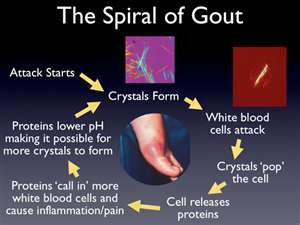
Gout occurs when excess uric acid (a normal waste product) collects in the body and needle-like urate crystals are deposited into the joints. This may happen because either uric acid
production increases or, more often, the kidneys cannot remove uric acid from the body well enough. Certain foods and drugs may raise uric acid levels and lead to gout attacks. These include
the following:
Foods such as shellfish and red meats (BE CAREFUL ONLY FOCUSING ON PURINES)
Alcohol in excess
Sugary drinks and foods high in fructose
Some medications like low-dose aspirin (but because it can help protect against heart attacks and strokes, we do not recommend that people with gout stop taking low-dose aspirin), certain
diuretics (water pills) such as hydrochlorothiazide (Esidrix, Hydro‐D), immunosuppressants used in organ transplants such as cyclosporine (Neoral, Sandimmune) and tacrolimus (Prograf)
Over time, increased uric acid levels in the blood may lead to deposits of urate crystals in and around the joints. These crystals can attract white blood cells, leading to severe, painful
gout attacks and chronic arthritis. Uric acid deposits can also be found in the urinary tract, causing kidney stones.
Who gets gout?
Gout affects more than 3 million Americans. This condition and its complications occur more often in men, women after menopause, and people with kidney disease. Gout is strongly linked to
obesity, hypertension (high blood pressure), hyperlipidemia (high cholesterol and triglycerides), and diabetes. Some other types of arthritis can mimic Gout; so proper diagnosis is the key.
Health care providers suspect gout when a patient has swelling and intense pain in one or two joints, initially, followed by pain‐free times in between attacks. Early gout attacks often start
at night. Diagnosis depends on finding the distinguishing crystals. The physician may use a needle to extract fluid from an affected joint and will study that fluid under a microscope to find
whether urate crystals are present. Crystals also can be found in deposits (called tophi) that can appear under the skin. These tophi growths occur in advanced stages of gout. Uric Acid levels in the blood are important to measure, but can sometimes be misleading, especially if measured at the time of an acute attack. Levels may be normal for a short time or even low during
attacks. Some may have increased uric acid levels, without the presence of Gout. X-rays may show joint damage in gout of long duration.
Points to remember
Bouts of arthritis that come and go are a sign of gout (see our gout stages page)
Finding the characteristic crystals in the fluid of joints allows health care providers to correctly diagnose gout.
There are natural ways to control gout. There is natural gout help available.
People with chronic gout usually require lifetime management to maintain lower uric acid levels.
Lifestyle changes such as controlling weight, limiting alcohol, increasing water intake, and making better food choices by increasing those that are alkaline to the system, can help control gout.
Order online 100% securely ~ All your information will be encrypted with 128 bit encryption (high) RSA with 1024 bit exchange.
*The products have not been evaluated by the Food and Drug Administration, and they are not intended to diagnose, treat, or cure any disease. We accept Mastercard, Visa, PayPal, and American Express. Copyright 1998-2024 Goutcure.com / Goutcare.com / OrderGC.com / Stopgout.com / Gout-Care.com / AHR4Health.com.
Alternative Health Research LLC T/A Smith and Smith Enterprises 11941 Main St. - Unit 130, Libertytown, MD 21762-1100 . All Rights Reserved. Privacy Policy
*These statements have not been evaluated by the Food and Drug Administration. These products are not intended to diagnose, treat, cure, or prevent any disease. " |
|